




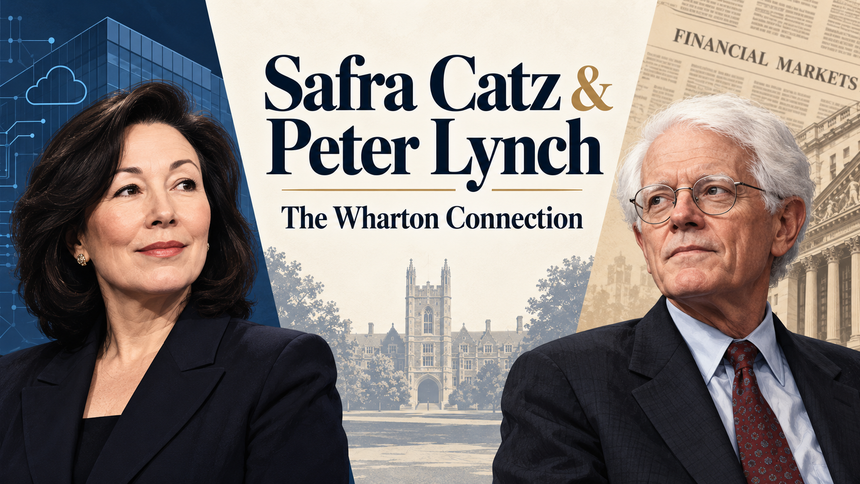

Safra Catz and Peter Lynch share a documented connection through the University of Pennsylvania’s Wharton School. Both are alumni, although they attended at different times and built careers in different areas of business.
Beyond that educational connection, the reliable public sources reviewed for this article do not establish a family relationship, a direct business partnership, or a mentor-and-student relationship between them.
Catz is known for her leadership at Oracle, where she previously served as chief executive officer and now serves as executive vice chair of the board. Lynch is best known for managing Fidelity’s Magellan Fund from 1977 to 1990 and explaining stock investing through widely read books.
Understanding their connection starts with separating their shared university background from their individual achievements.
The Wharton Connection: Different Degrees, Different Years
Wharton Magazine identifies Safra Catz as a member of Wharton’s undergraduate class of 1983 and Penn’s law school class of 1986. It identifies Peter Lynch as a member of Wharton’s MBA class of 1968.
That makes both of them part of the wider Penn and Wharton alumni community. However, they were not classmates, and their qualifications are not identical.
| Detail | Safra Catz | Peter Lynch |
|---|---|---|
| Wharton background | Undergraduate class of 1983 | MBA class of 1968 |
| Additional Penn qualification | Law school class of 1986 | Not established by the sources used here |
| Main career association | Oracle | Fidelity Investments |
| Best-known work | Corporate leadership and financial management | Mutual fund management and investment writing |
| Documented shared connection | Wharton alumni community | Wharton alumni community |
Their graduation years are 15 years apart. Sharing a university affiliation does not establish that they studied together, worked together, or maintained a personal relationship.
Wharton Magazine profiled both in its anniversary issue. Those profiles document their separate accomplishments within the same alumni community; they do not describe a joint career or collaboration.
Safra Catz’s Career Centers on Running a Business
Safra Catz’s professional background combines investment banking, corporate finance, and technology company leadership.
Before joining Oracle, she worked at Donaldson, Lufkin & Jenrette, where her positions included managing director in investment banking. Wharton Magazine reports that she joined Oracle as a senior vice president in 1999.
Her subsequent roles at Oracle included president, chief financial officer, and chief executive officer. This career placed her inside the company’s decision-making process, with responsibilities involving its finances, operations, and strategic direction.
Wharton’s historical profile also describes her involvement in Oracle’s acquisition of PeopleSoft. That is a useful example of her work: an acquisition requires decisions about what a business is worth, how it fits within the buyer’s strategy, and how the combined organization will operate.
Those responsibilities differ from selecting shares for an investment portfolio. A corporate executive helps shape the business itself, rather than simply deciding whether to own a financial stake in it.
Is Safra Catz Still Oracle’s CEO?
Safra Catz is Oracle’s executive vice chair, rather than its current CEO.
On September 22, 2025, Oracle announced that Clay Magouyrk and Mike Sicilia would become its chief executive officers and that Catz would become executive vice chair of the board. The announcement stated that she had served as CEO since 2014.
Oracle’s current executive biography confirms her executive vice chair position. Older articles describing her as Oracle’s CEO may accurately describe an earlier period, but they should not be used to establish her present title.
The distinction matters because executive positions change. An accurate account of her career needs to distinguish her long tenure as CEO from her subsequent board leadership role.
Peter Lynch’s Career Centers on Evaluating Investments
Peter Lynch became widely known through his management of Fidelity’s Magellan Fund.
Fidelity’s historical fact sheet lists his tenure as running from 1977 to 1990. Wharton Magazine reports that the fund averaged an annual return of approximately 29.2% during those years.
That figure describes the fund’s historical performance under his management. It is not a prediction of future returns or evidence that another investor can reproduce the result.
Lynch also reached readers through investment books written with John Rothchild, including One Up on Wall Street, Beating the Street, and Learn to Earn. These works helped explain business analysis and stock investing to audiences beyond professional fund management.
One recurring idea associated with Lynch is that everyday observations can provide a starting point for research. A customer might notice a popular product or a growing business before looking more closely at the company behind it.
Wharton Magazine illustrates this through Lynch’s interest in Hanes and its L’Eggs hosiery brand. His wife’s enthusiasm for the product attracted his attention, but he also investigated its distribution and business opportunity.
The meaningful lesson is that recognizing a promising product begins an investigation. It does not, by itself, establish that a company’s shares are attractively priced.
Their Work Involves Different Kinds of Financial Decisions
Catz and Lynch can be compared usefully, provided that the comparison does not imply an undocumented partnership.
Both careers involve understanding businesses and making decisions about money. Their responsibilities, however, operate at different levels.
Catz’s executive career concerns how a company uses its resources. Decisions may involve acquisitions, operating costs, organizational priorities, and the development of its business.
Lynch’s fund management career concerned which investments a portfolio should hold. That involves evaluating companies, considering their prospects, and assessing whether their shares offer a suitable opportunity at a particular price.
A hypothetical software company illustrates the difference.
An executive considering an acquisition would examine whether the target’s products fit the company’s strategy, how its employees and systems could be integrated, and whether the purchase would justify its cost.
A fund manager considering shares in the same business would examine its earnings, financial position, competitive strengths, growth prospects, and valuation. The fund manager could choose to buy or sell shares without taking responsibility for running the company.
These are related forms of business judgment, but they are not interchangeable measures of success. A corporate acquisition cannot be evaluated in exactly the same way as a mutual fund’s investment return.
What Is—and Is Not—Established About Their Relationship?
The evidence supports a limited, clear answer: Safra Catz and Peter Lynch are prominent business figures with a shared Wharton affiliation.
The sources reviewed do not establish that they are relatives, that Lynch mentored Catz, or that they created a joint business or investment strategy. Their official and institutional profiles describe distinct career paths.
That does not prove they have never met. Public biographies are selective, and private interactions may not be documented. It does mean that a specific personal or professional relationship should not be presented as fact without supporting evidence.
Likewise, their university connection does not establish that Lynch influenced Oracle’s strategy or that Catz’s decisions followed his investment philosophy. Such claims would require a documented statement, interview, or other direct evidence.
For readers searching for “Safra Catz and Peter Lynch,” the clearest answer is therefore their shared educational background and separate professional achievements. Catz’s career helps explain corporate leadership from inside a technology company. Lynch’s career helps explain investment research from the perspective of a portfolio manager. Their Wharton connection provides common ground, while their work shows two different ways of applying business knowledge.
Read more :Jason Luv Net Worth: Career, Earnings and Verified Facts